
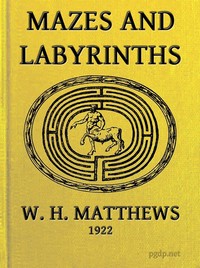
Mazes and Labyrinths: A General Account of Their History and Development
Published in 1922, W.H. Matthews's book is less of a straight story and more of a fascinating guided tour. Think of Matthews as your enthusiastic, deeply knowledgeable friend leading you through a global museum of twists and turns.
The Story
Matthews starts at the very beginning, with the confusing difference between a maze (a puzzle with choices and dead ends meant to trick you) and a labyrinth (a single, winding path to a center, meant for meditation). From there, he takes us on a walk through time. We see the famous Cretan legend of the Minotaur, not as just a myth, but as an early chapter in this design's life. We visit stone labyrinths on Scandinavian shores, likely used in fishing rituals. We get lost in the elaborate hedge mazes of European royalty, symbols of wealth and power. Finally, we arrive at the Victorian garden maze, a place for weekend amusement. Matthews connects these dots using old drawings, first-hand accounts, and his own clear curiosity, building a picture of how one simple idea took on a thousand different shapes.
Why You Should Read It
What makes this old book so readable is Matthews's genuine wonder. He isn't a distant academic; he's a guy who clearly got hooked on this topic and wants you to see what he sees. You feel his excitement when he describes tracking down a forgotten turf maze in an English field, or his frustration with the sketchy history of some designs. The book makes you look at the world differently. After reading it, you'll spot labyrinth patterns in unexpected places—on old coins, in church stonework, in the layout of some gardens—and you'll have a little bit of the backstory. It turns a quiet walk into a treasure hunt.
Final Verdict
This is a classic for a reason. It's perfect for anyone with a curious mind who enjoys history, design, or folklore. Gardeners will love the sections on hedge mazes. Travelers might use it as a quirky guide to historical sites. It's also a great pick for readers who like their non-fiction to feel like a friendly conversation rather than a lecture. Just be warned: you might finish it and immediately start planning a trip to find the nearest surviving labyrinth.
This digital edition is based on a public domain text. You are welcome to share this with anyone.
Linda Thompson
5 months agoThought-provoking and well-organized content.
Joseph Davis
1 month agoThe layout of the digital version made it easy to start immediately, the way the author breaks down the core concepts is remarkably clear. A rare gem in a sea of mediocre content.
Margaret Williams
1 year agoThe layout of the digital version made it easy to start immediately, the evidence-based approach makes it a very credible source of information. It cleared up a lot of the confusion I had previously.
John Miller
2 months agoI was particularly interested in the case studies mentioned here, the attention to detail regarding the core terminology is flawless. Top-tier content that deserves more recognition.




Jennifer Jackson
1 year agoI've been looking for a reliable source on this topic, and the level of detail in the second half of the book is truly impressive. I'll be recommending this to my students and colleagues alike.